
Location: International
Government of Bermuda
Bermuda Magistrate’s Courthouse & Hamilton Police Station
This 128,000 ft2 facility for the island nation of Bermuda includes five courtrooms, police facilities, an underground parking garage, detention cells suitable for overnight and weekend accommodations, a sally port, staff change and locker facilities, offices for court and police staff, and interview facilities.
HH Angus’ scope included mechanical and electrical engineering, IMIT, and AV design. The building is equipped with air conditioning and water retention tanks and is fully sprinklered. Water tanks collect rain water for both potable and fire protection requirements. Cooling equipment consists of air-cooled condensers and indoor compressors to minimize the exposure of equipment to the corrosive effects of salt-laden sea air.
The electrical scope included a high voltage power service, emergency power generator and corresponding dual distribution systems. Selected lighting, equipment and duplex receptacles were connected to emergency power.
The fire alarm system has dual annunciators. Smoke detectors were provided for each individual cell and located to avoid potential vandalism. Detectors were individually addressable in order to rapidly locate individual detectors triggering an alarm.
Fully-integrated closed circuit television, card access and door security monitoring systems were designed. The structured cabling system was a single mixed-media network to all information traffic - voice, video and data.
The latest audio visual technology was installed in the courtrooms: active sound reinforcement system, video system for the presentation of evidence, paging system for the judges, videoconferencing system for remote testimony and deposition, and digital recording system for proceedings recording. In addition there are dedicated elevators for prisoner transfer and additional retention cells adjacent to courtrooms.
SERVICES
Mechanical Engineering | Electrical Engineering | IMIT Design | Security and Communications Design
PROJECT FEATURES
Size: 128,000 ft2 | Status: Completed 2008
LOCATION
Hamilton, Bermuda
KEY SCOPE ELEMENTS
5 courtrooms, police facilities, underground parking, detention cells | Incorporated IMIT and AV design | High voltage power service | Emergency power generator and corresponding dual distribution systems | Structured cabling system as single mixed-media network for all information traffic - voice, video and data | Dedicated elevators for prisoner transfer
Canary Wharf Contractors Ltd.
Barclays Bank Headquarters & Computer Centre
Barclays Bank was named as one of “the 30 most significant buildings constructed in the past 30 years” in 2008 by the respected ‘Building Services Journal’.
The Barclays Bank building was singled out for its robust design, which featured a high standard of sustainability and energy efficiency, rare attributes for a high technology building. It also earned the UK's "Breeam Excellent" rating, comparable to LEED® Gold.
The tower consists of a main operations facility, data centre and trading floor with 32 floors above grade, 1,000,000+ ft2 of computer centre, trading floor and high technology office space. HH Angus provided an overall electrical and mechanical design that ensures there are no single points of failure.
Mechanical services were designed to achieve high quality practical solutions for the high cooling loads, while ensuring flexibility for subtenants and office churn. The systems boast dual risers and split plant for the majority of services in order to provide continuity of service for maintenance or in the event of failure.
Electrically, the building has an extremely resilient service provision with dual incoming electrical supplies, 8 MVA of UPS power and 12 MVA of generator power available. The design included dual 11 kV service entrance, a dual 11kV APS systems (12MW), a 2(N+1) UPS topology (8x800kW). All electrical services were provided in a dual riser and split plant format, providing continuation of service under failure or maintenance.
SERVICES
Mechanical Engineering | Electrical Engineering | Communication Design | Vertical Transportation Consulting
PROJECT FEATURES
Size: 1,000,000 ft2 | Status: Completed 2004
LOCATION
London, England
KEY SCOPE ELEMENTS
32-storey tower | Mechanical services tailored for high cooling loads | Provided dual riser and split platforms for all electrical services | Breem Excellent / LEED® Gold

Energy conservation
The mechanical services embrace practical energy conservation measures, such as pre-heating fresh air intakes using condenser water heat rejection.
Emirates Towers
NORR Limited, Architects and Engineers
This world-class development, located in Dubai, UAE, represented the third largest pair of towers in the world, with a 52-storey hotel tower and adjacent 53-storey office tower. Both towers rise from an oasis of shopping mall and lush lawns and gardens. At time of completion, the office tower was the tallest in the Middle East and Europe and the 10th tallest building in the world.
The total facility contains 41 elevators and 12 escalators, with the high-rise office elevators having a rated speed of 7 metres per second. Elevators employ artificial intelligence algorithms and VV/VF inverter drives as key features to achieve performance standards.
HH Angus provided a full scope of services, starting with Schematic Design and through to final acceptance inspections of the elevator and escalator units.
SERVICES
Vertical Transporation Consultanting
PROJECT FEATURES
Status: Completion 2000
LOCATION
Dubai, UAE
KEY SCOPE ELEMENTS
Tallest building in the Middle East at time of construction | Two adjacent towers | Named Elevator Project of the Year
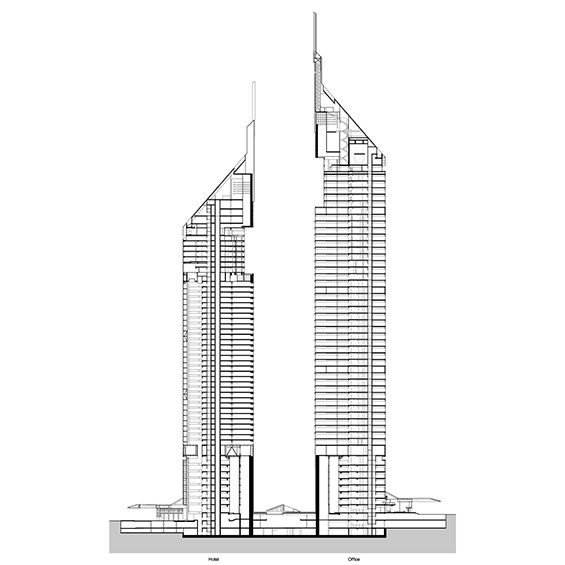
Image courtecy: NORR Ltd, Architects and Engineers
Elevator Project of the year
This prestigious project was selected by Elevator World Magazine as Project of the Year, Category One, Elevator New Construction, Year 2000.
Canary Wharf
Citigroup European Headquarters
This 1.2 million ft2 facility consolidates UK and European operations for Citigroup, the world’s largest financial institution. Our project scope included a 30,000 ft2 server farm/computer centre and 42 floors of communications technology rooms, supported by six 1600 kW rotary diesel UPS units for 9.6 MW of back up power to critical operations. At the time of construction, Citigroup Tower was the third tallest building in the UK.
Rotary diesel UPS units were arranged in four systems to provide dual redundant power to critical loads, using a highly fault-tolerant distribution scheme through to the raised floor Power Distribution Units and tech rooms. A sophisticated dual redundant load management system provides for control of all critical and essential loads under all normal operating and failure mode conditions. The design was configured to expand by two more 1600 kW units, for an ultimate load capability of 12.8 MW.
The control system also permits operation of all international office functions when all diesel UPS systems are available following a utility power failure via sequenced load stepping, allowing for a “business as usual” operating scenario even under widespread utility outages.
SERVICES
Electrical Engineering | Communications Design
PROJECT FEATURES
Size: 1.2 million ft2 | Status: Completed 2001
LOCATION
London, United Kingdom
KEY SCOPE ELEMENTS
Complex and highly resilient MEP design | Fly wheel energy storage UPS systems | Load design expanded by two 1600 kW units, for an ultimate load capacity of 12.8 MW | Rotary diesel UPS units arranged in four systems to provide dual redundant power to critical loads
Olympia & York Developments
Canary Wharf – One Canada Place & London Docklands Light Rail Transit Station
Olympia & York’s entire Canary Wharf project pivots on this 50-storey tower, which opened as the tallest building in Europe in 1991. The 1,248,000 ft2 building was designed to provide flexibility for incoming tenants to fit out the space to suit their own requirements.
The entire building supports extensive telecommunication infrastructure. Three separate phone companies have dual riser space allocated, resulting in an extremely high level of servicing.
HH Angus provided the electrical design for this landmark building. The electrical systems feature an extremely robust design with double-ended substations, (two transformers, one for redundancy) and a high level of service for the tenant floors.
The electrical power facilities parallel this highly-serviced design with double-ended transformer substations. The tenant and landlord power supplies are separated to reduce harmonic interference.
The building is totally smoke controlled. The computerized fire alarm system controls the smoke extraction and pressurization systems, as well as the lifts, and has expansion space to accommodate future tenant needs. One thousand tons of chilled water capacity has auto changeover facilities between separate HV services from two substations of the local utility.
Light Rail System
HH Angus also designed systems for the Canary Wharf station for the Dockland Light Rail system, which is built into the base of One Canada Square. The station was redeveloped from a small wayside station to a much larger one with six platforms serving three tracks and a large overall roof. It is fully integrated into the retail malls below the Canary Wharf office towers.
The Dockland LRT system is an automated light metro system that uses minimal staffing. In 2017/18, it carried almost 122 million passenger trips.
SERVICES
Electrical Engineering
PROJECT FEATURES
Status: Completed 1991
LOCATION
London, England
KEY SCOPE ELEMENTS
Robust electrical design with double-ended tranformer substations | High level of servicing | Designed systems for LRT station | Extensive telecommunications infrastructure and specialty lighting
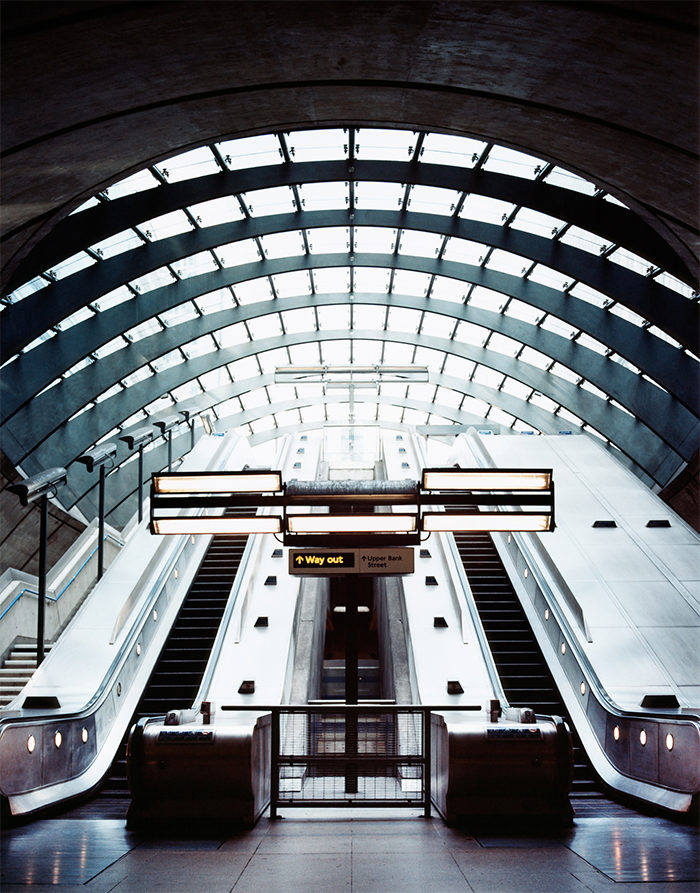
Lighting up London
Specialty lighting in the pyramid internally illuminates and reflects from the louvre vents to produce a glow that is visible at night from across the London skyline.