
Sector: Commercial
Cadillac Fairview
The Interchange - End-of-Trip Bike Facility
Located in the heart of downtown Toronto, the TD Centre attracts many occupants who commute or would like to commute by bicycle. Cadillac Fairview wabted to create a secure, amenity-rich facility that would encourage and support sustainable, two-wheeled commuting for their tenants.
The resulting facility has proven highly successful and was recognized for interior design excellence with a 2025 ARIDO Award.
The Interchange supports a shift toward sustainable mobility by making cycling a more convenient and appealing option for building occupants. The facility contributes to reduced traffic congestion, lower emissions, and improved occupant well-being, reinforcing the TD Centre’s position as a leading Class A office complex focused on sustainability and tenant experience.
HH Angus provided mechanical and electrical engineering services for The Interchange, a 9,385 ft² end-of-trip facility located in the TD South Tower at Cadillac Fairview’s Toronto-Dominion Centre. Supporting tenants who commute by bicycle, the facility delivers a high-quality, wellness-focused experience that promotes active transportation and enhances tenant amenities.
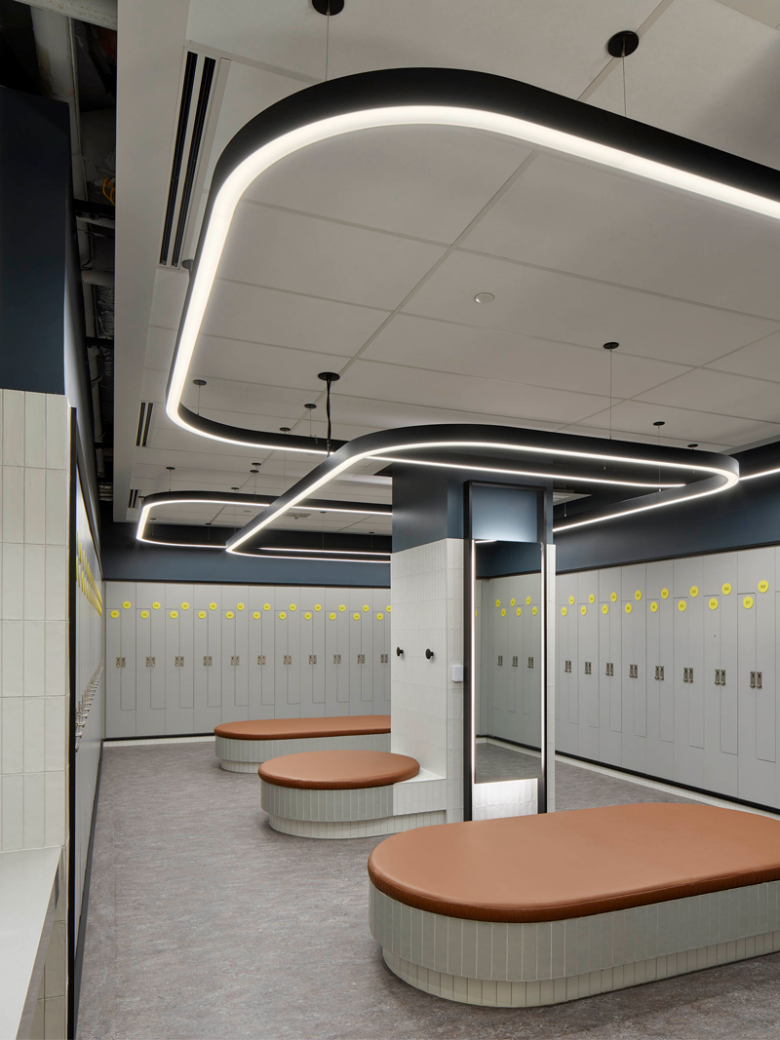
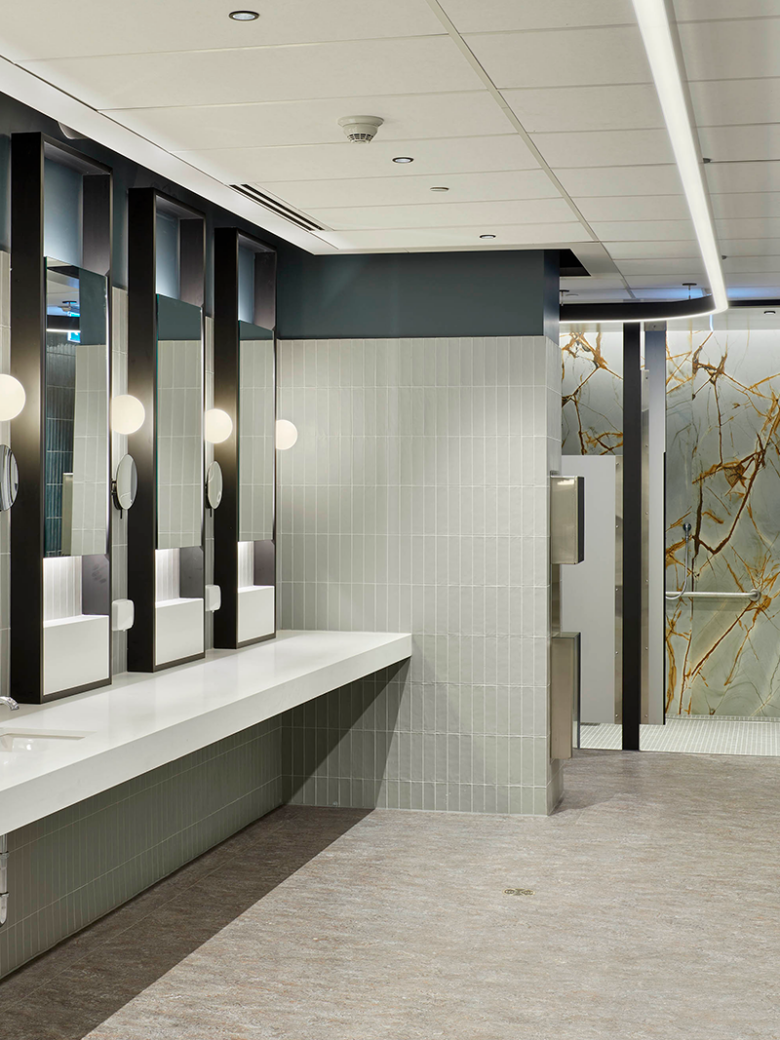
The Interchange includes 375 bicycle parking spaces, 260 full-height lockers, and 11 showers, along with secure 24-hour monitored bike storage. Premium features such as hair dryers, clothing steamers, and irons elevate the user experience, while the design prioritizes accessibility, inclusivity, and comfort for a diverse range of occupants.
HH Angus’ scope included the design of all heating, ventilation, air conditioning, plumbing, and sprinkler systems within the facility. The team also provided electrical engineering services to support wayfinding improvements in the underground parking garage, ensuring safe and efficient cyclist access.
A key feature of the project is the integration of the Eddy smart leak detection system, an IoT-enabled water management solution that uses sensors, automated valves, and real-time monitoring to detect leaks and mitigate potential damage. This system enhances operational resilience while supporting the client’s sustainability objectives.
The facility’s HVAC system incorporates a high-efficiency, 100% outdoor air-handling unit with heat recovery and an integrated heat pump. By capturing heat from exhaust air to precondition incoming air, the system maintains strong performance even in extreme winter conditions while improving overall energy efficiency. The compact, integrated design enhances reliability and simplifies installation within the constrained retrofit environment.
Retrofitting the facility within an active underground parking structure required careful coordination and design precision to maintain safe cyclist circulation and meet tight project timelines. HH Angus worked closely with the client and contractors throughout construction to ensure successful delivery.
SERVICES
Mechanical Engineering | Electrical Engineering
PROJECT FEATURES
375 bicycle parking spaces | 260 lockers | 11 showers | 24 hour monitored bike storage | Premium amenities | Accessible design
LOCATION
Toronto, Ontario
KEY SCOPE ELEMENTS
Heating, ventilation, air conditioning, plumbing and sprinkler systems, and wayfinding improvements
The sustainable choice
By making cycling a more practical and appealing choice, The Interchange contributes to a cleaner urban environment and a healthier workforce, while advancing the client’s sustainability goals.
Universal amenities
The amenity spaces had to meet high standards for quality, accessibility, and inclusivity, ensuring that all facilities were gender-neutral, universal, and welcoming to a broad user base.
Ontario Power Generation
Oshawa Headquarters
Ontario Power Generation set out to unite its various corporate offices into a single, modern facility that embodies collaboration, efficiency, and long-term sustainability. Repurposing the former GM headquarters brought new life to an iconic site. The project was recognized with a 2026 Award of Distinction from the Association of Consulting Engineering Companies - Ontario Chapter.
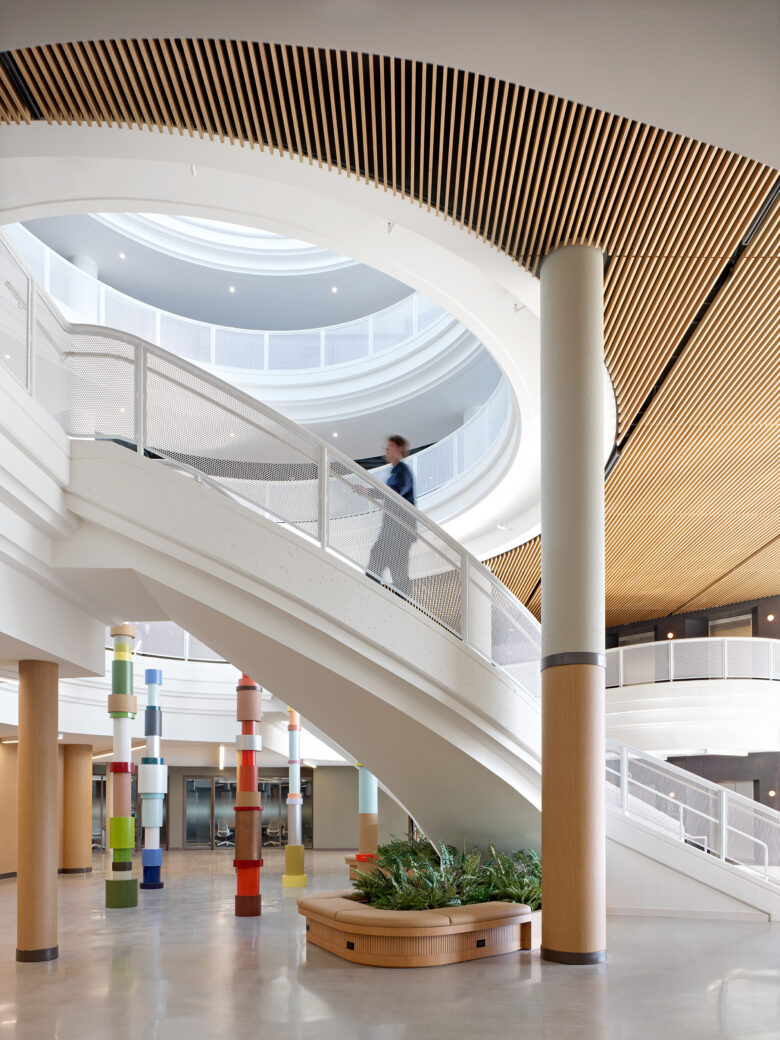
OPG selected Oshawa as its new corporate headquarters, purchasing and redeveloping a well-known building - the former General Motors (GM) administration building — a 285,000 ft2 facility with five levels (four storeys plus a lower concourse).
The project brought together OPG’s non-station staff from across the Greater Toronto area and Durham Region under one roof, transforming the existing structure through extensive interior and exterior renovations. Upgrades encompassed all major building systems, focusing on enhancing performance, comfort, and environmental responsibility.
HH Angus and Associates played a pivotal role as mechanical and electrical engineers, IMIT and lighting consultants, owner’s engineer, plumbing/fire protection/life safety designer, and commissioning authority.
The overarching goal was to create a future-ready workplace capable of supporting OPG’s operational and cultural needs for the next 40 years — targeting a net-zero carbon footprint and integrating leading sustainable design strategies throughout.
Meeting the objectives
HH Angus’ design solution had high sustainability and energy aspirations and involved the adaptive re-use and re-development of the GM administration building in Oshawa. HH Angus’ Commercial and Angus Connect teams came together for this project.
The project team successfully navigated a series of challenges that tested both creativity and collaboration, ultimately demonstrating their ability to deliver excellence under demanding conditions.
Materials and equipment
The unique use of materials was in fact the ‘re-use of materials’, significantly reducing deconstruction waste and embodied carbon. Much of the existing HVAC equipment was optimized (e.g., terminal heating and cooling devices) to enhance performance and capacity, rather than replacing the distribution network.
Internal resources, experience and expertise
To meet the demands of the accelerated schedule, the project team of mobilized a robust internal team, drawing on resources from across the firm. This collaborative effort, made possible by the firm’s size and depth of expertise, allowed us to maintain quality and precision while delivering on time.
Apart from strategic reuse of existing infrastructure, to accommodate increased occupancy, the design team included the use of energy recovery and thermal storage to allow system capacities to be sized below the peak demands to get the most out of the cost and embodied carbon of the equipment provided.
Outcome
Through ingenuity, collaboration, and technical excellence, the team successfully overcame these challenges—delivering a high-performance, cost-effective design that met the client’s objectives and ambitious goals, and reinforced their trust in the team’s ability to deliver innovative solutions under pressure.
SERVICES
Mechanical Engineering | Electrical Engineering | IMIT Design | Lighting Design | Owner's Engineer | Plumbing Design | Fire Protection | Life Safety Design | Commissioning Authority
PROJECT FEATURES
Size: 285,000 ft2, 5 levels (four storeys plus lower concourse) | Completed 2025 | Recipient of a 2026 ACEC/OEPA Award of Distinction for engineering excellence
LOCATION
Oshawa, Ontario
KEY SCOPE ELEMENTS
Interior and exterior base building renovation | Condensed design schedule | Mandatory sustainability requirements | Repurposing of original HVAC equipment | Heat pump technology | Air-to-air energy recovery | All new DALI Lighting Control System
Collaborative process
An interesting challenge was meeting the fixed project budget while delivering design integrity. To address this, the team dedicated many hours to an intensely collaborative process—partnering closely with manufacturers, vendors, and contractors to identify cost-effective solutions that preserved the client’s vision and design intent. Through innovative thinking, open communication, and strategic value engineering, the project was successfully delivered within budget while maintaining both functionality and aesthetic integrity.
Repurposing building systems
A further challenge emerged with the new interior layout, pushing existing building systems beyond their designed capacity. Rather than opting for a costly and disruptive full replacement of the distribution ductwork, the design team developed a strategic, resourceful solution. By introducing terminal heating and cooling devices to supplement the existing infrastructure, the required system performance was achieved efficiently and sustainably.
CN Tower
Lower Observation Level
The CN Tower's Lower Observation Level was completed and unveiled in January 2026, as part
of the attraction's 50th anniversary celebrations.
The refurbished area comprises 10,600 square feet, including both indoor and outdoor viewing areas, a
glass floor, stairwells, washrooms, and the SkyPod elevator lobby.
The project was designed to seamlessly extend the recently renovated Main Observation Level 3 aesthetic down to Outdoor Observation Level 2, creating a cohesive and elevated visitor experience.
This renovation marked the first major upgrade to Level 2 since the Tower opened in 1976. HH Angus provided comprehensive mechanical, electrical, lighting, and communications engineering services as part of the transformation.
Mechanical
Scope included the complete refurbishment of existing washrooms, the addition of a new fully accessible washroom, and modifications to the HVAC systems to accommodate the new slatted ceiling design and updated spatial configuration.
Electrical
Work included upgrades to electrical distribution systems and coordination of power requirements for sophisticated new audiovisual installations. LED linear lighting was integrated along the perimeter core walls, and major infrastructure upgrades were implemented to accommodate a future perimeter heated glass system.
Lighting
A new lighting design was developed throughout the space, including exterior colour-changing LED ceiling lighting at the Outdoor Observation Level. Perimeter lighting creates the Tower’s signature exterior glow, enhancing its nighttime presence. Emergency lighting systems were also upgraded as part of the project.
Communications
The project included new horizontal cabling infrastructure to support enhanced IT, AV, and security systems. Security enhancements included the deployment of new fixed and PTZ cameras to improve interior and exterior monitoring and support life safety objectives. New fibre optic cabling was installed, along with perimeter Color Kinetics lighting controls that contribute to the Tower’s distinctive exterior illumination.
SERVICES
Mechanical Engineering | Electrical Engineering | LIghting Design | Communications Design
PROJECT FEATURES
Size: 10,600 ft2 | Status: Completed January 2026 as part of the Tower's 50th Anniversary celebrations
LOCATION
Toronto, Ontario
KEY SCOPE ELEMENTS
Refurbishment of client amenities, HVAC, spatial configuration, electrical distribution system including future capacity for heated glass, new cabling infrastructure to support IT, AV, security, new lighting design throughout, perimeter lighting; exterior illumination

The visitor experience
The renovation creates a cohesive and elevated space, enhancing the new visitor activity options.


Air Canada
20 Queen Street - Office Fitout
Air Canada’s downtown Toronto office encompasses the entire 26th floor at 20 Queen Street West, with a total area of 20,000 ft2, including the elevator lobby.
For Air Canada's recent renovation, HH Angus provided mechanical and electrical engineering and ICAT design services.
The project featured high-end finishes in the reception area, café, a fully accessible washroom, integrated advanced lighting controls and multiple AC units to enhance occupant comfort and energy efficiency. The result is a modern, high-performance space custom tailored to the client’s needs.
SERVICES
Mechanical Engineering | Electrical Engineering | ICAT Design
PROJECT FEATURES
Size: 20,000 ft2 | Status: Completed 2025
LOCATION
Toronto, Ontario
KEY SCOPE ELEMENTS
Complete Interior fitout including elevator lobby | Advanced lighting controls | AC units
Opercule Urban Fish Farm
The Opercule Fish Farm project is a pioneering initiative in the heart of Montreal, representing the first urban fish farm in Canada. This innovative project is based on a unique approach to fresh fish production, combining cutting-edge technology, respect for the environment and a local supply network.
Opercule annually raises 25 to 30 tonnes of Arctic Char, a fish species highly prized by Montreal restaurants and residents, and raised without the use of chemicals, hormones or antibiotics.
The primary goal for the Opercule Fish Farm was to create an eco-friendly, sustainable fish farm with a low impact on the environment and providing excellent living conditions for fish. HH Angus worked closely with the client to understand their unique and ground-breaking vision and was able to design innovative solutions tailored to this one-of-a-kind project. The project’s design also stands out for its ability to produce fresh fish locally in a non-coastal city.
This model of aquatic urbanism fits perfectly into a context where demand for local, sustainable products is growing. Working with the HH Angus design and engineering team, Opercule is meeting Montreal’s appetite for Arctic Char by supplying top-quality fish while reducing the usual carbon footprint associated with transporting seafood from coastal regions.
The project's innovative design and short-supply chain production model allow Opercule to raise high-quality fish in an urban environment in response to a growing local demand for sustainable food products. Fish swimming in the morning can be on diners’ plates the same evening, frequently delivered to restaurants by e-bikes to further reduce the product’s carbon footprint.
SERVICES
Prime Consultant | Mechanical Engineering | Electrical Engineering
PROJECT FEATURES
Canada’s first urban commercial fish farm | Sustainable production processes | Reduced carbon footprint compared to traditional fish farming methods | Closed circuit production loop
LOCATION
Montréal, Quebec
KEY SCOPE ELEMENTS
Design and engineering to enable production of food fish in a dense urban environment, utilizing municipal services infrastructure| Production of technical reports for provincial Authorities Having Jurisdiction, due to uniqueness of the project | Custom design solutions to respond to changing operational conditions
Enabling production at scale
No design references or construction expertise existed for this pioneering enterprise, and the client placed their trust in HH Angus’ ingenuity and adaptability to deliver the vision.
The project’s key technical innovation was the development of the Recirculating Aquaculture System (RAS) system - the first of its kind in Quebec - which allows fish to be produced in a closed circuit, from egg to table.
From the outset, we worked very closely with Opercule to thoroughly understand the challenges and goals. The client had a strong vision for their new company, were deeply committed to its success, and actively involved in the project’s technical aspects. One of the owners brought a background in consulting engineering, and this made our collaboration highly productive.
Reducing environmental impact
The primary goal for Opercule was to create an eco-friendly, sustainable fish farm with a low impact on the environment and providing excellent living conditions for fish.
The RAS process is a sustainable model that significantly reduces the environmental footprint of the operation by reducing not only water but alsoenergy consumption compared to traditional aquaculture. The system minimizes the use of these precious resources, a crucial factor in an urban environment. By recovering, filtering and reusing water, the farm significantly reduces water consumption compared to traditional fish farming methods, which are often very water intensive. The system allows the company to reduce water consumption by 100 – 200 times compared to traditional systems.
In terms of waste management, Opercule uses environmentally friendly techniques to treat the organic and biological waste generated by production, helping to reduce overall environmental impact. The project also promotes use of sustainable materials for the construction and fitout of the facilities, reducing the carbon footprint of the entire system.
In addition, the absence of chemicals, hormones and antibiotics in fish production ensures no soil or water contamination. This approach helps preserve local ecosystems and eliminates the risk of pollution.
Engineering design challenges
The complexity of the Opercule project stems from a number of technical and logistical factors. The creation of an urban fish farm requires a completely unique design adapted to a dense urban environment. The design of a water recirculation system, intended to ensure the well-being of the product from the egg stage to the delivery of the fish, required the development and refinement of innovative technologies in filtration, nutrient management, and optimization of living conditions in confined environments.
Challenges included managing water quality, which is essential for fish health, as well as creating an optimal environment for rearing Arctic Char, known to be a delicate species. This challenge involved the creation of autonomous systems to maintain constant temperatures and pH levels, without the need for chemical treatments. In addition, bio-safety management was a priority to avoid contamination.
During the operational phase, it was discovered that the heat generated by the fish—even though they are cold-blooded—had been underestimated. This required adjustments to operational conditions to maintain stable water temperatures. Despite this challenge, our close collaboration with the client ensured these modifications were implemented effectively, showcasing the team’s problem-solving abilities.