
Service: Electrical Engineering
Woodbine Entertainment Group
Mohawk Racetrack
Woodbine Entertainment Group (WEG) is a longstanding and valued client, dating back to the late 1980s. Through our successes at Woodbine over the years, and the development of a strong relationship, we are privileged to fulfill the role of trusted advisor.
Mohawk Racetrack is a Canadian racetrack for Standardbred horse racing programs, owned by WEG, (formerly the Ontario Jockey Club).
At the Mohawk site, we engineered the addition of a 1250kW diesel generator and associated distribution equipment, which provides complete backup emergency power, plus redundant back up emergency power to the Slots floor.
HH Angus was also responsible for providing upgrades and new construction for the grandstand, including a new grandstand enclosure, M&E upgrades to the kitchens, and mechanical infrastructure upgrades to the chiller and boiler systems.
Additional work included:
- Racing improvements
- Slots/Gaming Floor renovation and expansion
- New administration area
- Site lighting
- Site electrical distribution upgrades
- Mechanical upgrades to chiller/boiler systems
SERVICES
Mechanical Engineering | Electrical Engineering
PROJECT FEATURES
Status: Completed 1999
LOCATION
Milton, Ontario
KEY SCOPE ELEMENTS
Addition of 1250kW diesel generator and relevant distribution equipment | Upgrades and new construction for grandstand enclosure | M&E upgrades to chiller and boiler systems
General Motors of Canada
Plant Additions
HH Angus has served as the Prime Consultant for a variety of automotive plant additions and renovations for General Motors. These are three of many projects for this valued client.
C/K* Truck Plant
HH Angus coordinated the 1,800,000 ft2 addition to both the building and building services for the new modular paint shop, body shop, paint oven enclosure and elpo phosphate process.
This project included the installation of three 633-ton chillers and one 250-ton chiller for building and process chilled water loads.
* C/K: C indicates 2-wheel drive trucks and K refers to 4-wheel drive.
GMT 800 Oshawa Truck Plant
This was a 300,000 ft2 addition to the existing C/K Truck Plant in Oshawa. Our project scope included coordinating architectural and structural design, mechanical/electrical design, and contract administration. The building is a 35 foot high, single-storey structure with insulated metal siding and 42,000 ft2 mezzanines with washrooms and one mezzanine for the welder water system. The project included a new 8,000 ft2 room and a quality measurement laboratory. The project included electrical bus duct distribution to process loads, as well as a quadruple-ended paralleled welding distribution system for welding robots.
Renovations to C/K Truck Plant
This project consisted of a four-bay addition with four levels to the existing paint shop facility at the Oshawa Truck Plant to house a new primer surfacer spray booth, accumulator conveyor, prep booth, freight elevator, storage, clean room and all associated building services.
SERVICES
Prime Consultant | Mechanical Engineering | Electrical Engineering
PROJECT FEATURES
Size: 1,800,000 ft2 | Status: Completed 1999
LOCATION
Oshawa, Ontario
KEY SCOPE ELEMENTS
1,800,000 ft2 addition | Installation of three 633-ton chillers and one 250-ton chiller | Prime Consultant for 300,000 ft2 plant addition
— Image courtesy of General Motors of Canada
Canadian Museum Construction Corp.
National Art Gallery of Canada
We are very proud of our contribution to Canada’s National Gallery, one of the country’s landmark institutions.
This project consisted of two buildings: the Gallery building of 549,000 ft2 and an administration building of ~54,000 ft2. The Gallery building houses Canada’s national art collection in state-of-the-art environmental conditions, with close control of temperature, humidity and high efficiency air filtration.
Each gallery has individual control of its environment, and high levels of humidity are maintained year round. Air with low of humidity levels is supplied to public circulation areas, such as the colonnade, galleria and Great Hall, to prevent migration of humidity from the art display galleries. Such migration could cause condensation on the large areas of exterior glass that enclose the building during the cold Ottawa winters.
In addition to the public galleries, administration offices and cafeteria, there are restoration workshops, authenticity and verification laboratories, paint and varnish shops, photograph storage, and fine art storage areas. A 200-car underground parking garage and loading dock were also incorporated.
The low-rise design of this gallery involved stairways and ramps as features, which eased the requirements for passenger elevators. Freight requirements, on the other hand, required large units for the movement of exhibits, with the doors of these elevators measuring up to 12’8” wide by 12’0” high.
SERVICES
Mechanical Engineering | Vertical Transportation
PROJECT FEATURES
Size: 550,000 ft2 | Status: Completed 1989
LOCATION
Ottawa, Ontario
KEY SCOPE ELEMENTS
High-efficiency air filtration with careful consideration to temperature & humidity | Individual gallery environmental control | Support spaces | Laboratories | Fine art storage areas | Large freight elevators for exhibit movement
Government of Canada
Fenbrook Medium Security Institution
This medium security institution is comprised of thirteen buildings with a capacity to house 400 residents, and provisions to incorporate another 100-bed unit.
The 260,000 ft2 facility includes: four residences, gatehouse, chapel, family visiting centre, a facility to accommodate industrial work, a building to house resident programs, a detention/segregation/health care centre, an administrative base cogeneration facility and a correspondence/visiting building.
HH Angus was responsible for the full mechanical and electrical design, as well as the site services package. Our scope of work included: sewers, wastewater pumping, stormwater collection, water mains, fire protection system, pumping and mains, central cogeneration and district heating plant, central emergency power generation, normal and emergency power distribution, communications distribution and site lighting.
The institution is located on an environmentally sensitive site, adjacent to a smaller minimum security institution. HH Angus undertook detailed studies to ensure that the impact of the facility on the surroundings would be as minimal as possible. One of the results this study was the realization that the planned on-site water supply and sewage disposal was not compatible with the commitment to environmental concerns. To address this, six kilometres of sewage and water mains were extended to the nearby town of Gravenhurst.
We also conducted a load-displacement cogeneration feasibility study as part of this project. The study concluded that cogeneration would be a worthwhile addition for this facility. The system consisted of:
- an 850 kW natural gas-fired reciprocating engine with engine coolant and exhaust gas heat recovery, coupled to a district heating system
- two dual fuel flex tube hot water boilers to provide supplementary heat
- variable speed secondary pumps to distribute hot water to the thirteen site buildings through a pre-insulated buried steel piping system.
SERVICES
Mechanical Engineering | Electrical Engineering
PROJECT FEATURES
Size: 260,000 ft2 | Status: Completed 1998
LOCATION
Gravenhurst, Ontario
KEY SCOPE ELEMENTS
Environmentally-sensitive site | M&E design included sewers, wastewater pumping, storm water collection | 6 km of sewage and water mains extended | Load-displacement cogeneration feasibility study was also conducted
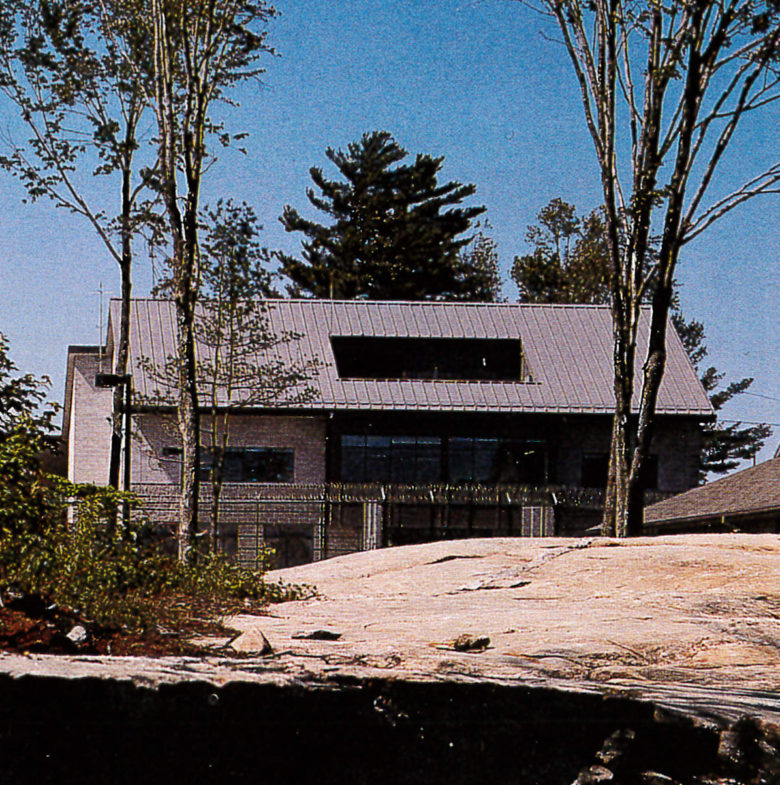
Protecting the Environment
Thanks to a pro-active approach by HH Angus, this institution benefitted from cost-effective and environmentally sensitive methods of servicing the facility.
— Image courtesy of Bondfield
City of Waterloo
Waterloo Recreational Complex
The Waterloo Recreation Complex consists of a 3,500 seat multipurpose arena, an eight lane, 35 metre swimming pool with a 400 seat gallery, a rolling bulkhead, a moveable floor, a leisure pool with slide, a whirlpool, tots pool, meeting and fitness facilities and a banquet bar area with a view of both the pool and the arena. Extra seating for an additional 2,000 people can be accommodated by temporary bleachers surrounding the rubberized running track which encircles the arena.
HH Angus provided design services for mechanical, electrical, and lighting, as well as contract administration for the construction of the sports complex.
A fully integrated ammonia/brine refrigeration system was installed for ice making and air conditioning, utilizing ice storage. Ice rink compressors were used to charge ice storage tanks for air conditioning, compressor heat recovery for building and pool heating, and airside heat recovery.
The ice making plant is comprised of four 50hp ammonia compressors and a single chiller. Ethylene glycol is distributed to make the ice surface, and the temperature of the ice can be customized to suit ice hockey, figure skating or curling. The ice rink is used 18 hours per day, seven days week, for 46 weeks of the year, and the facility is fully air conditioned.
In addition to maintaining the ice surface, any excess cooling capacity in the ice making plant is used to make ice, which is stored for reducing peak consumption of electricity of the air conditioning cooling plant. The rink also features a vacuum sand filter system,
The Complex was among only ten such facilities in Canada, the United States, Europe, and Australia to be honoured with the 1995 Award of Merit from Athletic Business Magazine.
SERVICES
Mechanical Engineering | Electrical Engineering
PROJECT FEATURES
Status: Completed 1993
LOCATION
Waterloo, Ontario
KEY SCOPE ELEMENTS
Installation of fully integrated Ammonia/Brine refrigeration system | Ice rink compressors used to charge ice storage tanks for air conditioning | Compressor added for heat recovery for building and pool heating