Today's Building Automation Systems provide a host of detailed data that is for identifying problems, but they also require that operators receive appropriate training.
As building owners require more data on the operational and energy efficiency of their facilities, building automation systems (BAS) are evolving to keep pace with this need for smarter buildings.
In HH Angus` role as consulting engineers for the design, engineering and commissioning of building systems, we are seeing numerous developments in the BAS products offered by manufacturers, and increasing use of the data available through the BAS.
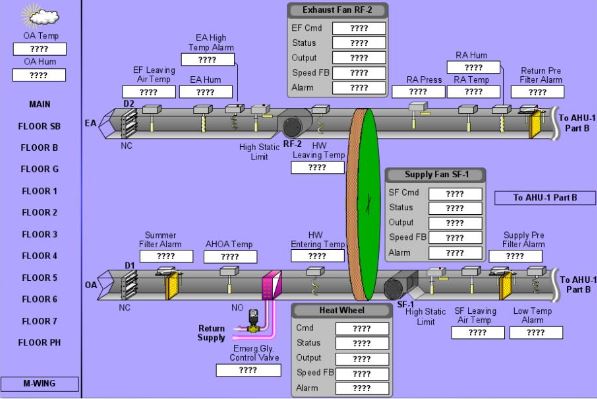
One recent development in the BAS field is in graphical representation. According to Mike Loughry, P.Eng., senior mechanical engineer at HH Angus, “Most BAS companies have made significant improvements in how they represent mechanical systems. We’re finding much more operator-friendly displays that convey detailed information in a more accessible interface. They include better use of colour, more animation and increased isometric or 3D drawings.”
The clearest advantage of the new graphics,” Loughry says, “is that they more realistically reflect the arrangement and layout of the equipment, which makes the operator’s job easier. The graphic display is more intuitively understandable compared to the older-style abstract diagrams. Owners and operators can more readily understand the information presented on the screen and can react faster and more appropriately to new data.”
Continuous commissioning advantages
Loughry also cites as an important development the availability of continuous commissioning systems. “These software packages monitor the operation and performance of building systems 24/7, looking for unusual events and calculating, for example, energy consumption. This helps to identify operational anomalies: if there is equipment failure, a spike in energy consumption or unusual system activation, the system will advise the operator. For example, if the BAS sees that a fan scheduled to operate from 7 a.m. to 7 p.m. is operating round the clock, the system will flag this.” Also it is becoming easier to take measurements at the specific system or equipment level. The building engineer can then identify systems that are the high energy users and focus improvements where they are most effective.
When it comes to upgrading existing buildings, Mark Benedet, P.Eng., a senior mechanical engineer and group manager in HH Angus’ technology division, cites the example of a building where systems dating back to the 1960s had been upgraded to pneumatic systems. That upgrade worked for a while, but the current occupants and facility managers are now demanding better results. In these cases, “We perform an evaluation to match available options with the client’s goals,” explains Benedet. “The clients can’t always upgrade the entire system at once, but there are a lot of levels of ‘doing better’ in energy efficiency. We can design new systems that will allow the electronics to talk to the control system or, if necessary we can update older systems with ‘interpreters’ so that those systems interface with new controllers. We also advise clients on energy grants that may assist them financially with equipment changeovers.”
Operations staff may need more training
With the new, highly functional BAS features, owners should be cognizant that their operations staff may need more training since their experience with these systems varies greatly. Engineers are learning to be much more detailed as to the type of training they specify when designing a sophisticated BAS system that includes complicated operating strategies. These strategies provide great benefits in energy consumption and flexibility. But in order to ensure the owner’s staff can operate the BAS equipment and efficiently deal with the range of data it provides, the training sessions have to be tailored to the knowledge level of the participants.
As Loughry points out, “Building owners rely on us for our expertise and for our knowledge of the various BAS technologies on the market. An operator may look at the BAS as a simple tool for starting/stopping equipment and adjusting temperatures. But we look at it from the point of view of providing many features, including ease of operation, equipment monitoring, innovative design, long-term energy consumption, and safety and code compliance. Clients count on us to understand and evaluate the options, make recommendations and inform them of the consequences of selecting particular systems. So it’s important that the required training is specified in the design documents to ensure the realization of the value of the systems being provided.”
How much is enough? … That depends
Determining the degree of sophistication required of a BAS depends on the purpose of the building in question. Data centres require high-quality equipment and an extraordinary degree of system redundancy across the board to meet uptime guarantees. Healthcare facilities must comply with stringent codes and the equipment must offer ease of service. They also have specialized requirements such as air pressure controls for infection control procedures. Commercial developers owning office buildings require BAS systems that can deliver reasonable temperature control measures, but perhaps without the expensive bells and whistles. Since they may not intend to operate the property long term, investing in comprehensive and expensive systems is not a priority for them. On the other hand, owner-occupied buildings such as hospitals are looking to maximize the life of their operating systems and minimize their maintenance costs, so a BAS that can address their controls automation needs now and for the next 50 years is a realistic and desirable investment.
“Consulting engineers have a responsibility to be very knowledgeable and to bring these technologies to the table during the design development stage. That’s part of the value we bring and where we can show leadership.”
- Senior Project Manger at HH Angus
Dovas estimates it will be a few years still before BAS equipment is standard in base building specifications, but that day is coming: “It’s important that the technology selected be web accessible and, if necessary, we need to educate our clients to make them aware of the power of the data they can measure. The days of controlling and measuring only the low-hanging fruit, for example lighting, are over. We know where the energy savings are, and the BAS trend data backs that up.”
Author:
Kirsten Nielson - Communication specilist, HH Angus
From Canadian Consulting Engineer - August-September 2015 print and digital issue, page 37-39.