
For many people, the term ‘digital twin’ is an elusive one and carries with it a certain mystery. As consultants, we see it as our responsibility to help clients understand just what a digital twin is and how it fits into their building asset strategy. The reality for many building owners is that a digital twin is typically not considered a priority for ‘today’, but rather a goal on the horizon to work toward. And that is where we help our clients maximize their building strategy and identify the foundational pieces needed to get to either a specific use case or a computer model of their entire facility. It's about building towards an integrated future.
Making the case for the ROI
Many building owners and facility managers are still grappling with how to define—and justify—the return on investment for digital twins. Part of the challenge is that the concept is often presented as an aspirational “future state,” making it difficult to connect with current operational realities. As a result, digital twins can feel abstract or overly complex, rather than practical tools delivering measurable value today.
A more effective approach is to start with clearly defined, near-term use cases. For example, optimizing a chilled water system can demonstrate tangible energy and cost savings, sometimes in the range of 20–40%. By focusing on specific systems or combinations of systems, organizations can begin to see real returns and build confidence in the broader potential of digital twin strategies.
However, the true value of a digital twin lies in moving beyond isolated optimization toward a more integrated, holistic view of building performance. Rather than analyzing systems in silos, digital twins bring together multiple data points—such as building systems, occupant behavior, and external environmental conditions—to provide a more comprehensive understanding of how a facility operates. This integrated perspective is particularly important in complex environments like laboratories, where system interactions significantly impact both energy use and operational outcomes.
There is also some confusion in the market about what digital twins actually look like. They are often associated with highly detailed 3D models, which can create the impression that advanced visualization is a prerequisite. In reality, many organizations are not yet at the stage where 3D modeling adds value. The priority should instead be on data integration, actionable insights, and scalable use cases that support operational and decarbonization goals.
By starting small, focusing on high-impact applications, and building toward greater integration over time, organizations can unlock the practical benefits of digital twins while laying the groundwork for more advanced capabilities in the future.

Testing real-world options in a virtual model
For existing facilities, one of the most compelling advantages of a digital twin is the ability to visualize complex building data in a spatial context. By overlaying operational data—such as occupancy patterns and energy use—onto a building model, facility teams can better understand how spaces are actually being used. This can reveal insights that are difficult to capture through traditional data analysis alone, such as movement patterns, underutilized areas, or equipment that is operating more frequently than expected. In environments where performance and efficiency are closely tied to how spaces are used, this level of visibility can inform more targeted and effective interventions.
This capability is particularly valuable in laboratories, where their continuous operation limits opportunities for real-world experimentation. Because these facilities must run 24/7 to maintain safety and environmental conditions, it is often not feasible to test new strategies directly in the live environment. Digital twins offer a way to address this challenge by enabling scenario testing in a virtual setting. By creating a digital representation that reflects real-world conditions, teams can explore the impact of potential changes—such as adjusting equipment schedules, modifying ventilation strategies, or introducing new technologies—without disrupting ongoing operations. These simulations allow organizations to evaluate sustainability measures in advance, reducing risk and increasing confidence in implementation.
A helpful way to think about this is as a working copy of the building: a parallel environment where changes can be tested, refined, and validated before being applied in practice. As digital twins continue to evolve, the ability to connect these virtual models with real-time data further enhances their value—providing a feedback loop that helps confirm whether implemented strategies are delivering the intended performance and decarbonization outcomes.
Where are we in the digital twin timeline
While interest in digital twins continues to grow, industry adoption is still in the early stages. The underlying technologies largely exist, but many organizations are only beginning to explore how to apply them. Rather than viewing digital twins as a single solution to implement, it is more accurate—and more effective—to think in terms of a long-term strategy that evolves over time.
Digital twin development is often described along a maturity curve. At the foundational level, organizations may begin with elements such as 3D models or asset data—capabilities that, in many cases, already exist within design models or advanced building automation systems. The next step is less about adding new tools and more about connecting what is already in place: breaking down silos between systems, aggregating data, and enabling a more integrated view of building performance.
There are also practical barriers that can slow progress. In some cases, systems are not designed to communicate with one another, limiting the ability to integrate data. In others, the necessary data simply is not being captured—for example, due to gaps in metering or monitoring infrastructure. Without access to reliable, relevant data, even well-defined use cases can be difficult to implement.
Over time, these challenges are likely to diminish as technologies mature and industry practices evolve. For now, however, most organizations are focused on building the foundational capabilities that will enable more advanced digital twin applications in the future.
As maturity increases, this integration supports more advanced insights and, ultimately, more automated or predictive operations. However, reaching that level requires a strong foundation. Many organizations today are still at the early stages—developing strategies, identifying priority use cases, and piloting targeted applications.

Don’t forget your roadmap
For organizations starting from a clean slate, one of the most important, and most overlooked, steps is defining clear use cases from the outset. This begins at the highest level, with organizational goals. Whether the priority is operational efficiency, sustainability, or long-term asset performance, these objectives should guide every subsequent decision.
This top-down approach mirrors established BIM practices: start with what the organization is trying to achieve, then determine how assets will be managed, and from there define the data, systems, and equipment required to support those outcomes. When applied to digital twins, this ensures that technology decisions are driven by purpose—not the other way around.
A common misstep is to begin with a specific technology or vendor solution and attempt to build a strategy around it. Because while these tools may offer value, they are not always aligned with an organization’s specific needs or long-term goals. By contrast, starting with clearly defined outcomes allows organizations to identify the right systems and data requirements to support meaningful use cases.
A structured roadmap can help translate this strategy into action. Rather than approaching digital twins as a large, all-at-once investment, organizations can break the journey into manageable steps. This might involve:
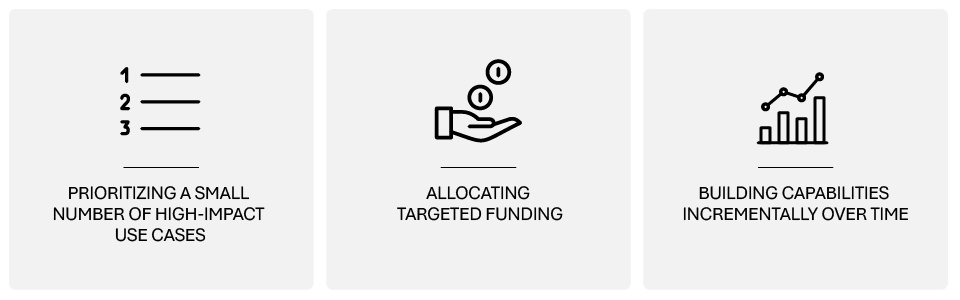
Taking this phased approach makes implementation more practical and cost-effective, while still aligning with a broader vision. By focusing on achievable milestones, organizations can demonstrate value early, build internal momentum, and progressively expand their digital twin capabilities in a way that supports long-term decarbonization and operational goals.
Identifying early wins
When it comes to achieving early returns, some of the most impactful opportunities are also the most fundamental: measuring performance and making that data usable. Many organizations have set ambitious decarbonization and ESG targets, but without reliable data, it is difficult to track progress or make informed decisions. Establishing the ability to monitor key metrics—such as energy use, system performance, and occupancy—is often the first and most valuable step in a digital twin strategy.
Once this foundation is in place, organizations can begin to identify inefficiencies and adjust operations accordingly. Even at the level of individual systems, improved visibility can lead to meaningful energy and cost savings. However, greater value emerges as data from multiple systems is brought together.
Integrating systems enables more coordinated and responsive building operations. For example, occupancy signals from one system—such as lighting—can be used to inform another, like ventilation, allowing building systems to respond dynamically to actual usage. While this type of integration may be more complex in specialized environments like laboratories, the principle remains the same: connecting data across systems creates opportunities for smarter, more efficient control strategies.
Ultimately, the progression from measurement to integration supports a more holistic approach to building performance. By starting with accessible data and building toward more connected systems, organizations can unlock practical, high-impact improvements that advance both operational efficiency and sustainability goals.
Reducing risk and cost in existing labs with digital twins
For existing laboratory facilities, the path forward is not about wholesale replacement, but about making better use of what is already in place. Because these facilities are operational, they offer an immediate advantage: access to real performance data. This creates an opportunity to begin measuring how systems, equipment, and spaces are actually being used, and to use those insights to guide targeted improvements.
Digital twin strategies in this context often start with focused use cases. This might include analyzing how occupants move through a space, how frequently specific equipment is used, or how energy consumption varies across different lab environments. These insights can be applied at multiple levels—whether examining individual pieces of equipment or understanding how a lab interacts with the broader building systems.
One of the most valuable early applications in laboratories is predictive maintenance. Given the critical nature of lab operations, equipment failure is not only costly but can also compromise research and safety. By leveraging connected systems and real-time data, digital twins can help identify early warning signs of equipment issues, enabling proactive maintenance and reducing the risk of unexpected downtime.
In parallel, digital twins support ongoing tracking of energy, carbon, and resource use, providing a clearer picture of performance over time. They also create a platform for testing potential upgrades—such as new equipment or operational changes—in a virtual environment before implementing them in the real world.
Importantly, these benefits can be realized incrementally. With a clear strategy in place, organizations can align capital planning with long-term digital twin goals. For example, when equipment is due for replacement, specifying systems that are capable of capturing and sharing data ensures that each investment contributes to a more connected, intelligent facility over time.
By taking a phased, data-driven approach, existing lab facilities can steadily improve performance, reduce operating costs, and advance decarbonization—without disrupting critical operations.

Should you start with a pilot project
Pilot projects can play an important role as valuable entry points in moving digital twin initiatives forward. In many cases, facility teams are already aware of specific challenges or improvements they want to pursue. Targeted pilot projects—focused on a particular system or use case—allow organizations to demonstrate value quickly, without waiting for a fully developed, enterprise-wide strategy.
That said, pilots are most effective when they are guided by a broader vision. Understanding the long-term direction—what systems need to be connected, what data will be required, and how different use cases may evolve—helps ensure that early investments support future integration. Without this context, there is a risk of implementing solutions that are difficult to scale or connect later.
A thoughtful approach combines both elements: a clear roadmap informed by a comprehensive understanding of existing systems and data, alongside focused pilot projects that deliver early results. This enables organizations to build momentum while maintaining alignment with long-term goals.