
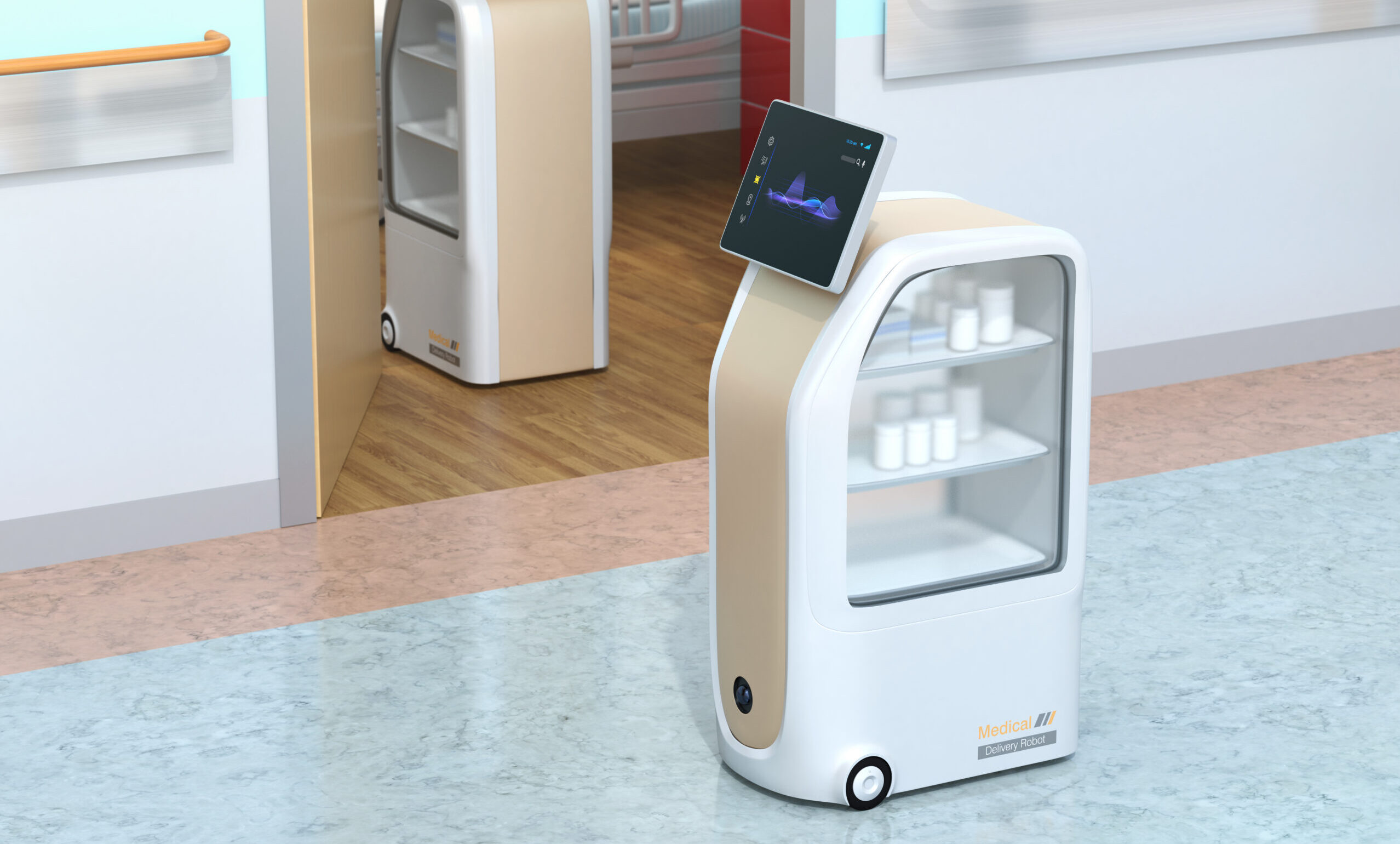
At the new St. Paul's Hospital, automated transport is being designed to keep support staff closer to clinical teams, not simply move carts faster.
By Preethi Sethi, RDMS, CRGS, MSc eHealth, Lean | Angus Connect
A cart of soiled linen is ready to leave a patient floor. A support worker pushes it to the elevator, waits, rides down to the service area, exchanges it for clean linen, then makes the trip back.
It is a familiar journey in a hospital, repeated often by people moving food, supplies, linen, and waste.
At the new St. Paul’s Hospital in Vancouver, that routine raised a different question: what if the support worker did not have to leave the floor?
For Don Wills – lead for automated logistics planning at new St. Paul’s – that became one of the most important possibilities created by automated guided vehicles (AGVs): “What if we use automation to rethink how support services work, not simply how carts move? The vehicle could move the cart. The support worker could stay closer to the clinical team.”
That idea shifted attention to the part of the journey that automation does not complete: the last 30 metres.
Where automation stops
Don describes the “last 30 metres” as the distance between the dedicated AGV elevator and the final point where materials are ultimately received and put away. The phrase captures a service ambition and a clear vision: someone in the last 30 metres is there to receive the delivery and help the clinical team use what has arrived.
An AGV can bring a cart to the floor. It cannot understand what has changed on the unit that morning, nor can it coordinate several support services arriving at once, or build a working relationship with the people using what it delivers.
That's where Don sees a different role for support services: "as a multi-skilled worker based on the floor who knows the unit, coordinates incoming services and becomes a familiar point of contact for the clinical team. This person is a ‘quarterback’ for support services – someone who can see what is arriving, understand what the team needs next, and coordinate the final handoff. A smart device could notify them when AGV deliveries are approaching.”
The planned linen workflow makes the change easy to see. An AGV would take soiled linen down to the service area and return clean linen to the floor, while the support worker manages the final handoff and connects that delivery with what the floor needs.
The opportunity is not simply to move carts differently. It is to use people’s time differently and thus keeping support staff closer to the clinical teams they serve.
VIDEO - Don and Preethi discuss new St. Paul’s Hospital’s service vision behind the last 30 metres and the role of a support colleague on the floor.
Protecting the last 30 metres in the design
The “last 30 metres” may sound like an operational issue, but it is also a building-design issue. Keeping major send-and-receive destinations closer to the elevator core helped protect the efficiency the AGV system was intended to create. As a hospital design develops, those relationships can change.
Don recalls one example from the new St. Paul’s design process: “Pharmacy had originally been planned in the sub-grade support services area. During design, it moved to the fifth floor, well away from the core service elevator intended to support its regular AGV movements. That change created a longer route for a department that would frequently send and receive materials.”
The team revisited the arrangement and ultimately swapped the pharmacy and laboratory locations. Keeping the elevator core central to the destinations it serves helped preserve the shorter journeys behind the last 30 metres.
The example points to a simple design-review question: When a department moves, what happens to the route its materials must travel? A change that looks reasonable on a floor plan can quietly add distance, waiting, and handling back into the workday.
Turning a service idea into a working system
From Angus Connect’s clinical consulting perspective, the service model has to survive the transition from an idea into the functional program, design documents and equipment specifications.
As AGV Compliance Advisors to new St. Paul’s Hospital, we help maintain that connection through planning and design – reviewing how operational intent is reflected in the building, workflows and equipment requirements as the project evolves; for example:
- If a floor-based worker is expected to receive carts, there must be an appropriate place to receive them.
- If that person is expected to coordinate several services, the operating procedures need to support that responsibility.
- If a cart needs to work both for the service using it and for the automated transport system moving it, that requirement has to carry through into equipment selection and procurement.
While these details may seem removed from the original service vision, they are what give that vision a place in the building.
Designing the work as well as the route
Don also recognizes that bringing support services together is not simply a technology or design exercise: it changes work: “Creating a multi-skilled floor role raises important questions about responsibilities, training, change management and labour relationships. New St. Paul’s had the opportunity to undertake that work during a period of growth, with plans to retrain existing support services staff for the new role.”
Don's advice to other hospitals is to begin with the service they want staff and patients to experience, then work backwards. Understand the daily routines. Involve the people who perform them. Decide how responsibilities may need to change. Then make sure the building and its systems support that way of working.
New St. Paul’s is still planning toward this model. Its real test will come in operation, when staff experience and the movement of materials reveal how well the pieces work together.
For another hospital beginning the same conversation, the first step does not need to be complicated. Walk a familiar delivery route with the people who use it. Follow the cart all the way to its destination. Stay for the arrival and put-away. Notice where people wait, where they double back, and what takes them away from the colleagues they support.
Then walk the last 30 metres. Ask who will be there when the cart arrives and what they need to make the delivery useful.
Those answers belong in the plan every bit as much as the vehicle does. Because the real opportunity with automation isn't simply to move materials differently; it's to create a better way of working for the people who deliver and receive them.
Considering AGVs for your hospital?
Angus Connect can help connect your service model with the planning, design and equipment decisions needed to support it.
Contact Preethi Sethi here.