
Sector: Energy Infrastructure
Enwave Energy Corporation
District Energy System Cogeneration Plant
District energy is a key component of Toronto’s climate action plan, to reduce emissions from buildings and help the City reach its greenhouse gas (GHG) reduction target of 80% by 2050. Buildings currently generate about half of the GHG emissions in Toronto.
Enwave is the largest District Energy Systems in North America. The system has enough power to supply over 180 office buildings.
This project started in 1962 with an original feasibility study and culminated in the design and construction of a central plant and distribution system with an installed capacity of 800,000 lbs. of steam per hour.
The deep lake cooling system was added later, and makes use of the 40°F/4°C water in Lake Ontario. It has a total capacity of 75,000 tons of refrigeration, which is sufficient to air condition 3.2 million m2 / ~34 million ft2 offices.
Clients with whom we have worked on the Enwave District Energy System include:
- Hudson Bay Company
- Bank of Nova Scotia
- Cadillac Fairview Toronto Dominion Tower Plaza
- Royal Bank Plaza
- Mt. Sinai Hospital
- Toronto General Hospital
- Women’s College Hospital
- The Hospital for Sick Children
- Li Ka Shing Knowledge Institute
- St. Michael’s Hospital
SERVICES
Prime Consultans | Project Mangeres | Electrical Engineers | Mechanical Engineers
PROJECT FEATURES
Status: Complete 2019
LOCATION
Toronto, Ontario
KEY SCOPE ELEMENTS
Provided technical advisory for heating and colling systems | Introduced over 5 miles of piping for high-pressure steam district heating | The deep lake cooling system makes use of 40°F/4°C water in Lake Ontario

Supplying miles of steam
The system supplies high-pressure steam for district heating via an underground distribution system of over five miles of piping in downtown Toronto.
Trusted advisor
HH Angus has served as a technical advisor to Enwave over many years, consulting on various engineering aspects of the heating and cooling systems.

Ontario University – Confidential
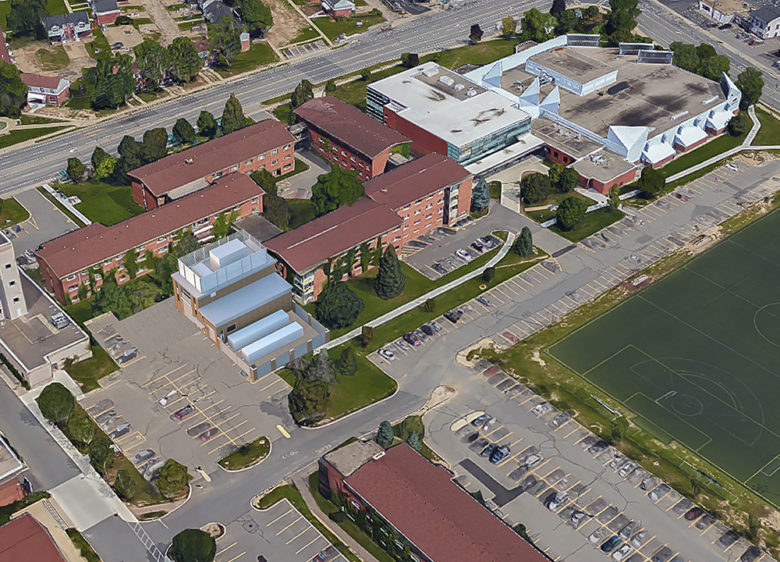
BESS & Microgrid System
The battery energy storage system facility reduces electrical demand for a Class A electricity facility operating during anticipated Global Adjustment hours.
Johnson Controls, the turnkey EPC and facility energy service company, engaged HH Angus to engineer a 2 MWe (4 MWh) behind-the-meter battery energy storage system (BESS).
The installation is part of a microgrid design that incorporates rooftop solar panels for six buildings (~500kWe), a 2 MWe (4 MWh) BESS, and a 2 MWe natural gas engine-generator peaker. The goal of the installation is to reduce Global Adjustment charges. It also supports much of the facility in the event of a power failure on the grid.
The solar panels and BESS were installed during spring and summer of 2018, and the engine-generator peaker plant has been submitted for a building permit.
SERVICES
Prime Consultant | Electrical Engineering
PROJECT FEATURES
Status: Completed 2021
LOCATION
Ontario
KEY SCOPE ELEMENTS
Engineered 2 MWe (4MWh) behind-the-meter battery energy storage | Microgrid design including solar, BESS, NG engine- generator peaking plant for six buildings
Energy innovation funding
The project was predicated on receiving Government of Canada Strategic Innovation Fund support for innovative energy projects.
Canadian Food Inspection Agency
Electrical Upgrade
HH Angus was engaged to upgrade the electrical distribution at the Canadian Food Inspection Agency, a regulatory body inspecting food, animals, and plants to protect the health and well-being of Canada’s people, environment and economy.
Our initial task on this project was to investigate existing major electrical systems and provide a concept design to replace and upgrade the existing equipment, which had reached end-of-life. Prior to implementation, we developed detailed phasing sequences to minimize the impact of power outages on the client’s operations.
Key design elements included replacing equipment with up-to-date technology, increasing capacity to ensure long service life, and meeting anticipated building usage. We also added power factor correction to reduce electricity costs for anticipated future rate structures. The new design provided flexibility for power distribution and technology. The client’s expectation was the replacement of main electrical equipment should carry the building reliably for at least 25 years.
HH Angus’ scope of work included design engineering services for replacement of 2 main 13.8kV underground service feeds – two 2000kVA dry transformers, two 600V switchboards feeding the building services, 600v switchboards that supply another 15 various 112.5KVA/150 KVA/225KVA-rated 600/208-120 dry transformers, 208/120V CDP distribution panels, MV/LV power cables, power factor capacitors and some transfer switches. In addition, associated equipment auxiliaries were replaced or upgraded. We also managed coordination, testing and commissioning of the replacement equipment.
SERVICES
Prime Consultant | Joint Venture | Electrical Engineering
PROJECT FEATURES
Status: Completed 2017
KEY SCOPE ELEMENTS
Review and upgrade of existing end-of-life equipment | Developed detailed phasing sequence to minimize the impact of power outages | Power correction factor added to reduce future electrical costs | Replacement of two 13.8 service feeds & transformation
Public Works & Government Services Canada
Tunney’s Pasture
HH Angus was engaged as Prime Consultant on a chiller plant installation for this public building in Ottawa. The project installation serviced nineteen buildings with a total floor space of ~3,170,000 ft2 and was comprised of two chillers @3500 tons.
Tunney’s Pasture is a 49-hectare (121 acre) mixed-use campus in Ottawa, including government services, commercial offices and residential buildings. Its existing steam-driven chillers were at end of life and operating with R22 refrigerant, the import and production of which is banned as of January 2020. Also, the use of river water for free cooling needed improvement and the river water pumping system was not operating efficiently.
HH Angus, in joint venture with Goodkey Weedmark, was retained to undertake conceptual studies to evaluate changing the chillers from steam power to electrical power. We also made recommendations for improving the free cooling aspects of river water and making more effective use of the river water pumping system.
HH Angus provided conceptual evaluation of replacing the chillers, in terms of efficiency, physical location and necessary steps required to change from steam to electrical power. Once the chiller concept was resolved, we evaluated optimization of the river water pumps to undertake the condenser water cooling and considered how to efficiently use the free cooling available from the river in low load conditions.
Optimizing free cooling and condenser water, using river water instead of cooling towers, resulted in energy efficiency and reduced carbon footprint for this installation. We also identified benefits to the client through improvement in chiller efficiency using the latest technology, and the elimination of boiler operation during the summer months.
SERVICES
Prime Consultant | Mechanical Engineering | Electrical Engineering
PROJECT FEATURES
Status: Completed: 2017
LOCATION
Ottawa, Ontario
KEY SCOPE ELEMENTS
Evaluation to optimize river water pumps to undertake condenser water cooling & efficient use of free cooling from the river in low load conditions | Consulted on technology that would eliminate boiler operations during summer months
Enwave Energy Corporation
Pearl Street Cogeneration Plant
HH Angus provided design and engineering services for Enwave’s CHPSOP 2.0 contract to install a 2 x 2 MW Cogen project at the Pearl Street plant.
The Pearl Street steam plant is one of two major boiler plants that service Enwave’s downtown Toronto heating system, and usable plant space there was a significant constraint. The new cogeneration was to be installed in limited space in the basement.
We first undertook a feasibility study to determine whether the existing basement would accommodate a 4 MW single engine or 2 x 2 MW engines. Based on the study results, Enwave selected the 2 x 2MW option.
The initial phase of the detailed design was to determine which cogeneration engines would be options, given the space constraints. It was established that only one supplier’s equipment would fit. The next phase involved pre-tenders, including engine generator sets, heat recovery steam generator, selective catalytic reduction, and switch gear.
Plant design used 3D software to ensure all equipment could fit without coordination clashes. The combustion and ventilation required were a major challenge, entailing architectural changes to the building to meet code, and a new area way on the outside of the building, to allow for combustion air and ventilation air. The engine generator had to be disassembled at the distributor and reassembled on site. The focus then moved on to locating a suitable routing for the breeching and silencers off the engine exhausts, which had to travel from the basement to the roof.
In a CHPSOP 2 contract, the client is exporting power into local LDC (Toronto Hydro). HH Angus designed protection, monitoring, and control requirements per Toronto Hydro’s embedded generation technical interconnection requirements.
HH Angus coordinated with Toronto Hydro, on behalf of the client, for: revenue metering CTs/PTs to install in the switchgear hydro compartment; metering cabinet; and commissioning of the synchronization test, protection, and SCADA points. We also issued a signed, embedded generation commissioning report.
SERVICES
Mechanical Engineering | Electrical Engineering
PROJECT FEATURES
Status: Completed 2017
LOCATION
Toronto, Ontario
KEY SCOPE ELEMENTS
Use of 3D plant design to ensure all equipment could be accommodated | Design restricted by space constraints | Design, protection, monitoring & control requirements per Toronto Hydro's embedded generation technical interconnection requirements